Backtest
Backtest
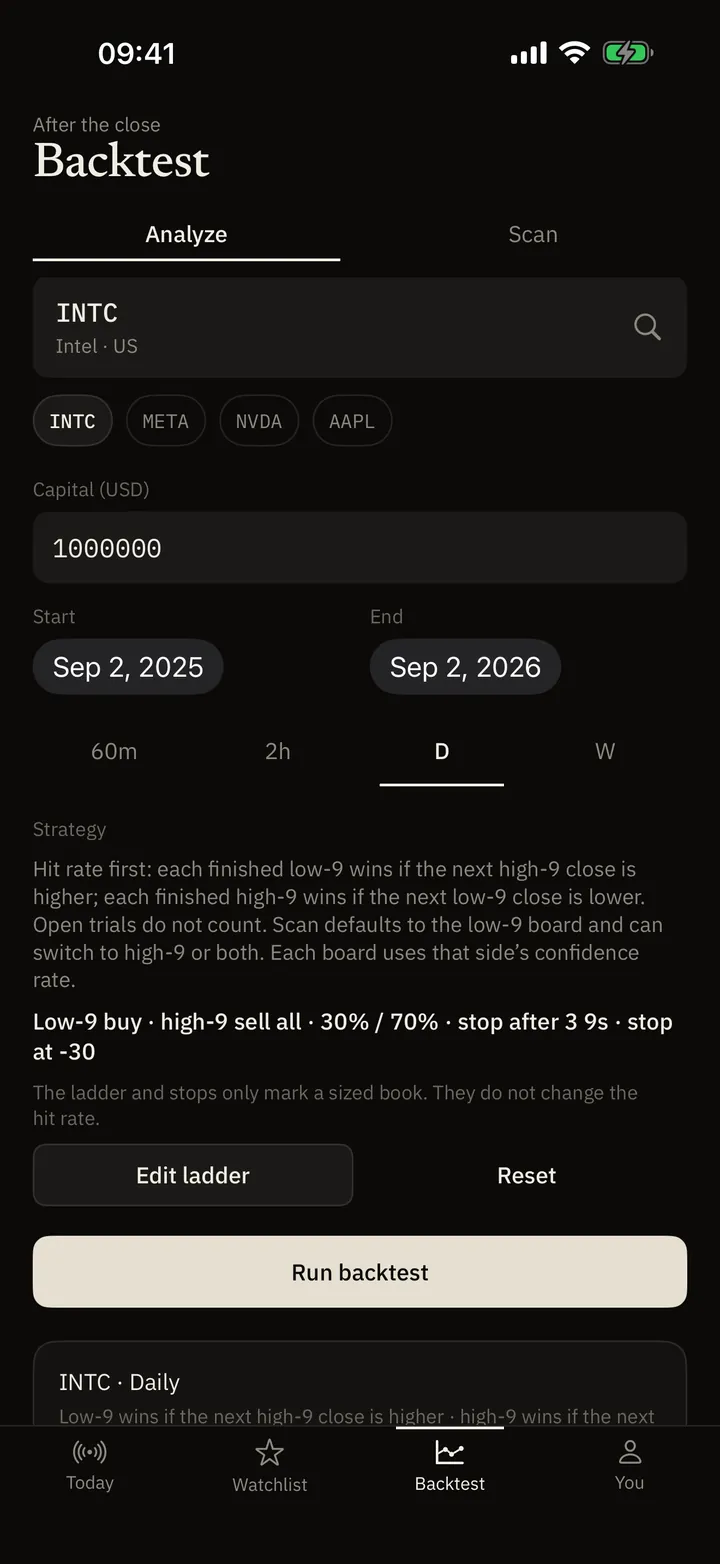
If the number on a name still feels thin, you can replay finished 9s. Analyze is that one name. Scan is the same settings across a market list. Structure stats count finished 9s. The research ledger is a separate long-only simulation with costs. Neither is a list of names to buy.
What this is for you
- Same rules across names: You can compare finished 9s on one timeframe and window, then open a single result instead of rebuilding charts.
- Two readings, kept apart: Directional structure stats are not strategy PnL. A high-9 can print a negative raw move and still match a defined direction.
- Coverage is visible: Each result shows source, actual observation dates, and when data is short or truncated. Incomplete rows stay out of a comparable scan rank.
- Costs are not hidden: Default ladder: add 30% then 70%, hold 10 bars, 5 bps fee and 5 bps slippage per side, stop after 3 finished 9s in the open cycle, and a 30% loss versus cost. Set a stop to 0 to turn it off. Pro can edit the ladder.
Open Backtest
Analyze is the name in front of you. Scan is the same settings across a market list.
For one name: pick dates and timeframe
60-minute, 120-minute, daily, weekly, monthly. Intraday is Pro and history is short. Free clips you to 365 days and the default ladder.
On Pro you can edit the ladder
Percents, how long you hold (or wait for the opposite 9), fees, slippage, consecutive low-9 stop, close-loss stop. Restore defaults if you want the stock setup.
Run, then read the report in order
The header keeps this name and timeframe. Check the actual observation dates and any warning that data is short. Structure is directional rates. Activity is fills. Open rounds stay out of the win-rate.
Scan is a list, not the whole exchange
Pick a market and optional sectors. You get the hot list plus Watchlist plus names you add. China can search a broader A-share list as extras — it still does not auto-scan every listing.
Do not rank names with a handful of samples
A comparable scan row needs at least 4 finished pairs. The score is the 95% Wilson lower bound of the recency-weighted rate, in percent. A pair closed today weighs 1; one closed two years earlier weighs 0.5. It is not the chance of the next 9.
How to read the ledger without treating it as a track record
A structure observation starts on a finished 9. Fixed-horizon mode compares that close with the close N bars later (default 10). Opposite-9 mode waits for the next opposite 9. Unfinished tails do not enter the rate. Observations may overlap; they are not compounded as independent trades.
The ledger is long-only research. A finished low-9 can add exposure at the next bar’s open, with adverse slippage. Exits use the next open after the hold or after an opposite high-9. Stops can fire first. The last bar is marked to the close; the app does not invent a final exit fill.
The passive comparison is full exposure from the first in-window open, same entry costs, marked to the last close. It is not index alpha.
This is not point-in-time constituents, not whole-share trading, not limit-up handling, and not a live track record. Survivorship follows today’s pool. History does not forecast.
FAQ
Is the win rate the chance of the next 9?
No. The win rate is the share of finished observations in this window that met the chosen rule. The scan score is the 95% Wilson lower bound of the recency-weighted rate, in percent. Neither is the chance of the next 9.
Why can structure look fine while the ledger does not?
Structure can overlap and ignores costs. The ledger pays fees and slippage, can stop out, and only counts completed rounds in its win rate. Read them as two jobs.
Why is a scan row incomparable?
Short or truncated history, missing warmup, or too few finished pairs. The app keeps those out of the comparable rank instead of filling gaps.
Does Scan run every A-share?
No. Hot list plus Watchlist plus extras you add. That is a research pool, not a full-market dump.
Replay a finished 9 on your phone
Run Backtest in the iOS app. Questions: support@nineradar.com.