Symbol
How to read a name
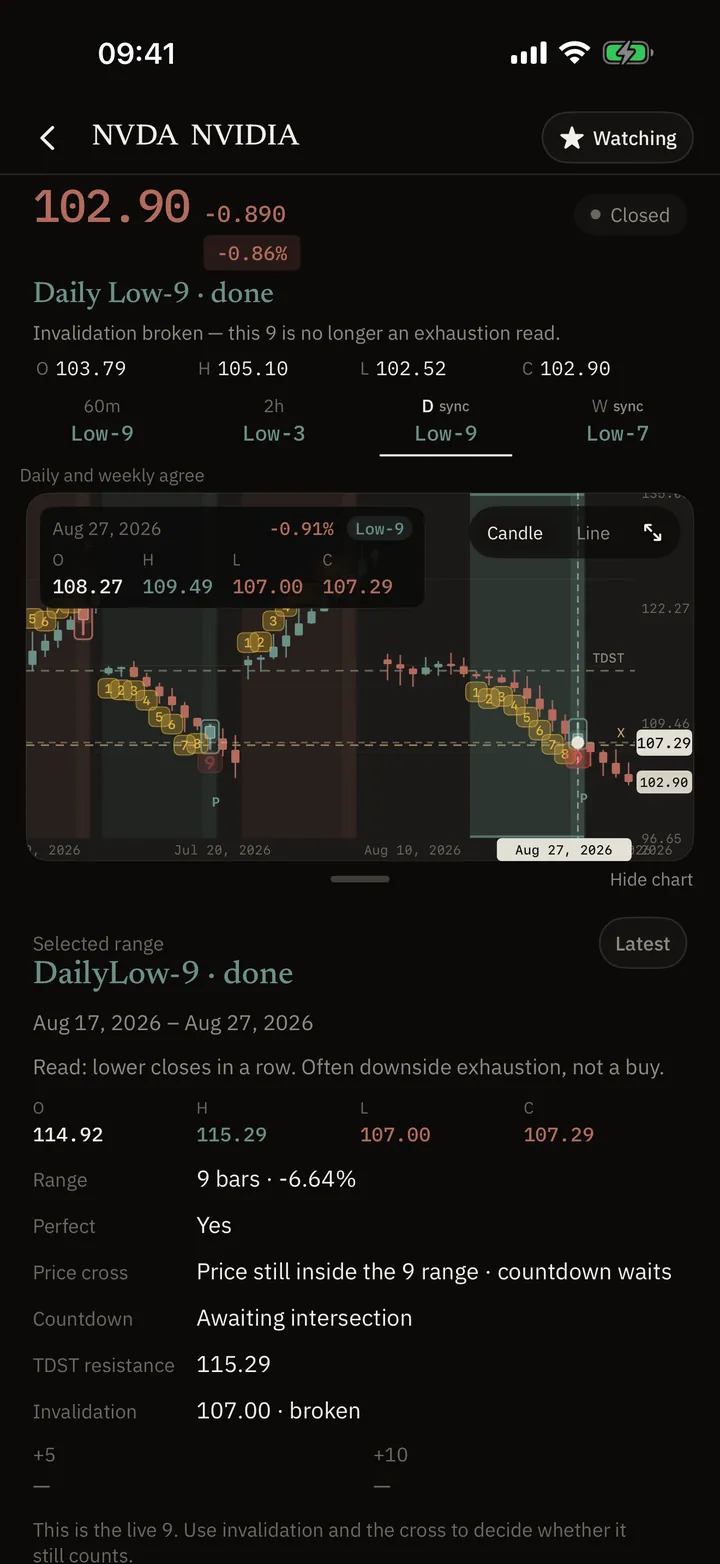
When a number on the list is worth checking, you open one name on one timeframe. You should see why that number is that number: latest close versus the close four bars earlier, what the next close would do, and whether this bar has settled. A finished 9 is a completed count, not a promise that price turns.
What this is for you
- The count has a source: C versus C−4 is on the page, with dates. You can overlay the reference close on the chart.
- Open versus closed is labeled: Quote basis is the daily last. Timing says whether this timeframe’s bar is still open, closed, behind, or unverified.
- Next bar is a condition, not a tip: If the current bar stayed unchanged, a close below the reference would print the next low count; above, the next high. Equality resets both.
- History is a sample, not a forecast: Finished 9s list +5 and +10 moves. Small samples are labeled. Ranges are observed, not a guarantee.
Open it from Today or Watchlist
You see the code and name. Star adds it to Watchlist (eight on Free).
Pick the timeframe you actually mean
Daily and weekly wait for the close. 60- and 120-minute are Pro. Counts of 6–8 paint from 6. A finished 9 paints 1–9 on that run.
Check whether this bar has closed
The daily last can differ from this timeframe’s last bar. If the page says the period is still open, the count can still move.
Read C versus C−4
C is the latest close; C−4 is four bars earlier. Lower counts low, higher counts high, equal breaks the count. Turn on the overlay if you want that reference on the candles.
Read the next close as a condition, not a tip
It assumes this bar does not change. After a finished 9, a new count starts at 1.
Then the structure brief
What to watch next, how old the 9 is, whether daily and weekly agree. Pro adds Perfect, countdown, TDST, and invalidation. None of these is an order.
Tap a 1–9 stretch on the chart
Compare it with the latest. Landscape opens fullscreen. Drag the crosshair into a band to compare that window.
History, a note, or replay — if you still want them
Finished 9s show +5/+10. Alerts on this page stay on this timeframe. Replay keeps this name and timeframe.
How not to fool yourself
Fail the ninth and 1–8 vanish. That is the rule, not a bug. A trend can print several 9s and never turn.
Perfect means bar 8 or 9 is more extreme than 6 and 7. It is a qualifier, not a second signal. TDST is the true high or true low of a finished 1–9 window. A break is labeled; it is not a broker stop.
Daily and weekly can agree, oppose, or only one side is at 6+. Confluence is a reading, not a vote to trade.
CN and HK counts try Tencent forward-adjusted bars, then East Money, then Yahoo adjusted closes. Other markets use Yahoo adjusted closes. An unadjusted broker print can differ.
FAQ
Why do labels start at 6?
While the count is 6–8, bars 1–5 are counted but not painted. When 9 completes, that run is painted 1–9.
The count went to 8 and then disappeared.
The next close failed the C versus C−4 test, so 1–8 vanished. That is an unfinished setup, not a missing file.
Is a 9 a reversal?
No. NineRadar does not treat 9 as a buy, sell, or guaranteed turn. History on the page is what happened after finished 9s in this sample.
Why does next-bar look hypothetical?
It assumes the current bar stays unchanged. During the session that bar can still move. Equality versus the reference resets both directions.
Why is the last price different from my broker?
CN and HK counts try Tencent forward-adjusted bars, then East Money, then Yahoo adjusted closes. Other markets use Yahoo adjusted closes. Vendors and sessions differ. The comparison shows the two bar dates. Use the broker for an order.
Read the evidence on a name
Open a symbol in the iOS app. Questions: support@nineradar.com.